

Hypermobility, Laxity and Instability: Using Our Words with Care
Hypermobility, laxity and instability get used interchangeably in clinic, but they describe three different things. Getting them straight changes how you assess a joint, what you treat, and what your patient believes about their body.
The three core concepts
1. Laxity
The ligament itself is longer or more extensible than usual. It's a structural property of the tissue, and it shows up clinically as excessive accessory movement at the joint.
Laxity can be:
congenital, from a connective tissue disorder or genetic variation
acquired, from years of repetitive stretching, pregnancy hormones or immobilisation
localised or generalised
Laxity doesn't automatically mean symptoms. You can have lax ligaments and feel fine. It doesn't automatically mean instability either. The joint can still work well if the muscles compensate.
2. Hypermobility
The joint moves through a greater physiological range than is typical for that person's age, sex and population (Castori et al., 2017). It's about how much the joint actually moves.
Hypermobility can come from:
ligamentous laxity
muscle laxity or altered neuromuscular control
anatomical variation, such as bone shape or attachment points
a combination of these
Hypermobility isn't instability, and it isn't pathological in itself. Plenty of athletes, dancers and performers have hypermobile joints and function well.
3. Instability
The feeling, the observation, or both, that a joint lacks control or support.
Subjective: "My knee feels like it's sliding", "My joint feels like it's going to give way".
Objective: poorly controlled movement, apprehension, or compensation patterns you can see.
Instability can happen with or without laxity or hypermobility. You can feel unstable with normal ligaments if control is poor. You can have significant laxity and feel completely stable if the muscles are doing their job. Instability is the symptom and the functional problem, and it's usually what brings people in.
How muscles change the picture
Muscles are the dynamic stabilisers. Strong, well-coordinated muscles can protect a lax joint and take away the feeling of instability. Poor neuromuscular control can make a joint feel unstable even when the ligaments are normal.
In hypermobility, what we often see clinically is muscles working overtime, which brings fatigue, pain and dysfunction with it. Proprioception can be affected too. A meta-analysis found people with joint hypermobility syndrome had poorer lower limb joint position sense and movement detection than people without it, though the upper limb picture was less clear (Smith et al., 2013). Movement patterns then adapt to protect the joint, which can create secondary problems elsewhere.
So you can have significant structural laxity with functional stability through muscular compensation. You can also have normal laxity with functional instability through poor neuromuscular control.
Laxity, altered neuromuscular control and inadequate strength or endurance together are one pathway to biomechanical compromise in this group. But symptomatic hypermobility is multifactorial. Proprioception, pain processing, movement habits and much more all play a part.
The knee as an example
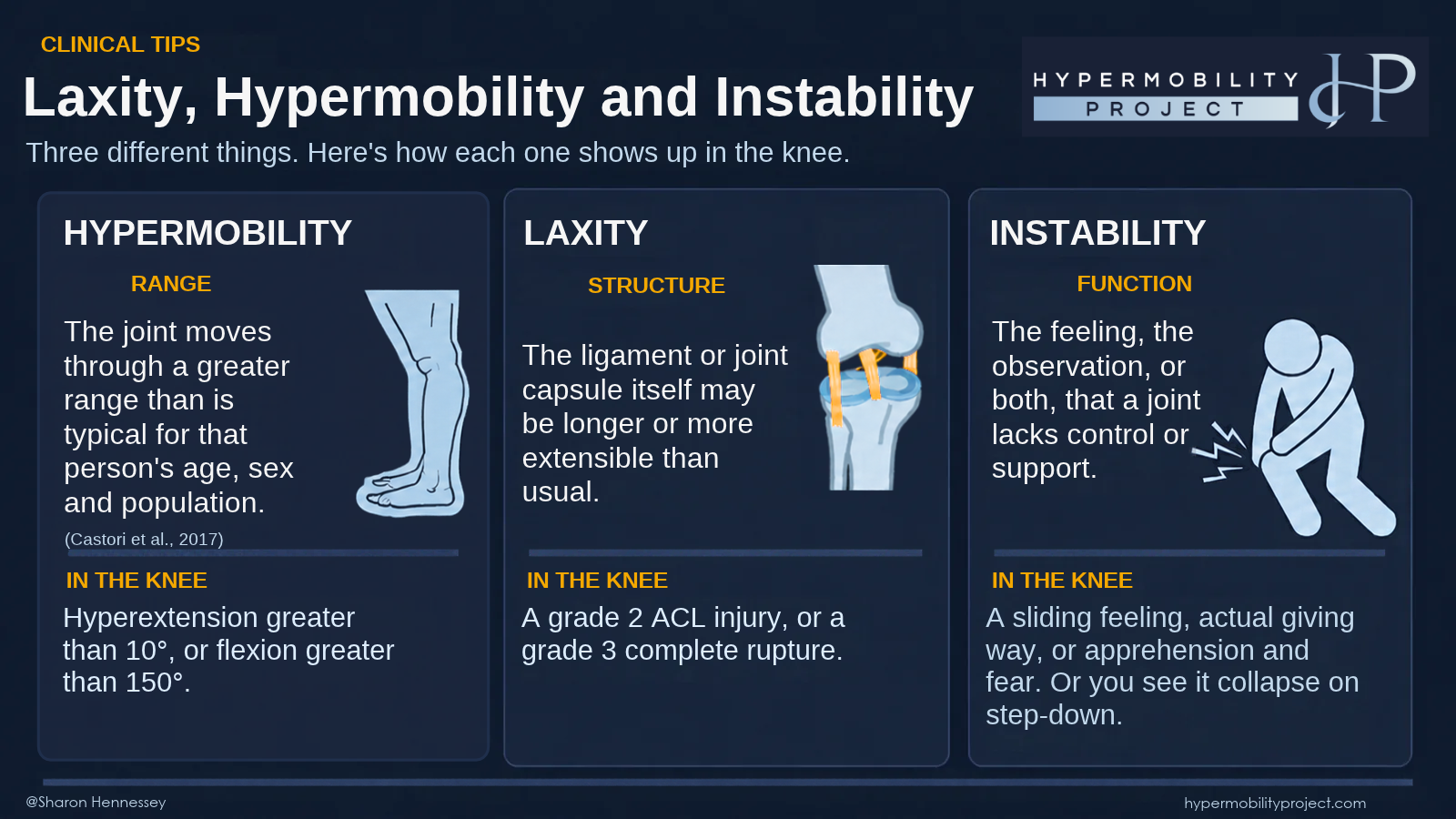
Take a knee that hyperextends when someone stands. That's hypermobility: the joint moves through more range than is typical.
Now test the ligaments. If I feel more glide than usual on an anterior drawer, or a lot of give through varus and valgus, that's laxity. The ligaments are longer or more extensible.
Instability is different again. It's the person telling me their knee feels like it's sliding or going to give way, or me seeing it collapse when they step down.
Any one of these can turn up without the others. A knee can hyperextend and feel completely stable. A knee can have lax ligaments and cope well because the muscles are doing their job. And a knee with normal ligaments can still feel unstable if control is poor.
The language problem: laxity versus instability
Laxity and lengthened ligament describe structure. They're neutral words. Instability is a loaded word. It suggests dysfunction, loss of control and danger, and it's multifactorial. It isn't only about ligament length.
When a patient is told they have "instability", they often hear that their body is broken, their joint doesn't work and they need to be careful. They may think they could seriously hurt themselves. That fear is real, and it works against them.
A patient with a lengthened ACL, a good end feel and poor neuromuscular control has a lax ligament with inadequate muscle control. That's a very solvable problem. Call it instability, though, and their beliefs shift. Protective strategies go up, they move less, their muscles get weaker, and the problem gets worse.
We already know this from knee injuries. A torn ACL, or a knee that's unstable on testing, doesn't automatically mean surgery. In a randomised trial of young, active adults with an acute ACL tear, about half of those who did rehab first, with surgery only if they needed it, never had a reconstruction. At five years they were doing as well as the people who had early surgery (Frobell et al., 2013). People get stronger, gain control of the joint, and often don't need it. The same thinking applies to a lax, hypermobile joint.
The goal is to be precise in our language, honest about what we're assessing, and careful not to create fear through the words we choose.
Clinical gem
What word did I use, and what did my patient hear?
For a structured approach to assessing hypermobility itself, see the Diagnosing Hypermobility Masterclass and our clinician tools.
About the author
Sharon Hennessey is a physiotherapist with almost three decades in practice and a specialist focus on hypermobility. She is the founder of Not Just Bendy Hypermobility Services and The Hypermobility Project, which offers courses, resources and evidence-informed education for clinicians working with hypermobile patients.
References
Castori, M., Tinkle, B., Levy, H., Grahame, R., Malfait, F., & Hakim, A. (2017). A framework for the classification of joint hypermobility and related conditions. American Journal of Medical Genetics Part C: Seminars in Medical Genetics, 175(1), 148-157. https://doi.org/10.1002/ajmg.c.31539
Frobell, R. B., Roos, H. P., Roos, E. M., Roemer, F. W., Ranstam, J., & Lohmander, L. S. (2013). Treatment for acute anterior cruciate ligament tear: Five year outcome of randomised trial. BMJ, 346, f232. https://doi.org/10.1136/bmj.f232
Smith, T. O., Jerman, E., Easton, V., Bacon, H., Armon, K., Poland, F., & Macgregor, A. J. (2013). Do people with benign joint hypermobility syndrome (BJHS) have reduced joint proprioception? A systematic review and meta-analysis. Rheumatology International, 33(11), 2709-2716. https://doi.org/10.1007/s00296-013-2790-4
This resource is designed for education and general guidance only. It is not a replacement for personalised medical advice.