
Does a Stronger Shoulder Mean a Better Shoulder? What New Research Shows for Hypermobility
Does getting stronger make a hypermobile shoulder feel better? A new analysis from a Danish trial says it helps function a little, but it doesn't explain much of the change, and it isn't linked to a meaningful drop in pain (Christensen et al., 2026).
The study
The Shoulder-MOBILEX trial, run by Behnam Liaghat and colleagues at the University of Southern Denmark, compared heavy and light shoulder exercise in adults with hypermobility spectrum disorder (HSD) and shoulder pain or instability (Liaghat et al., 2022). This analysis looked at 76 of the trial's 100 participants (Christensen et al., 2026).
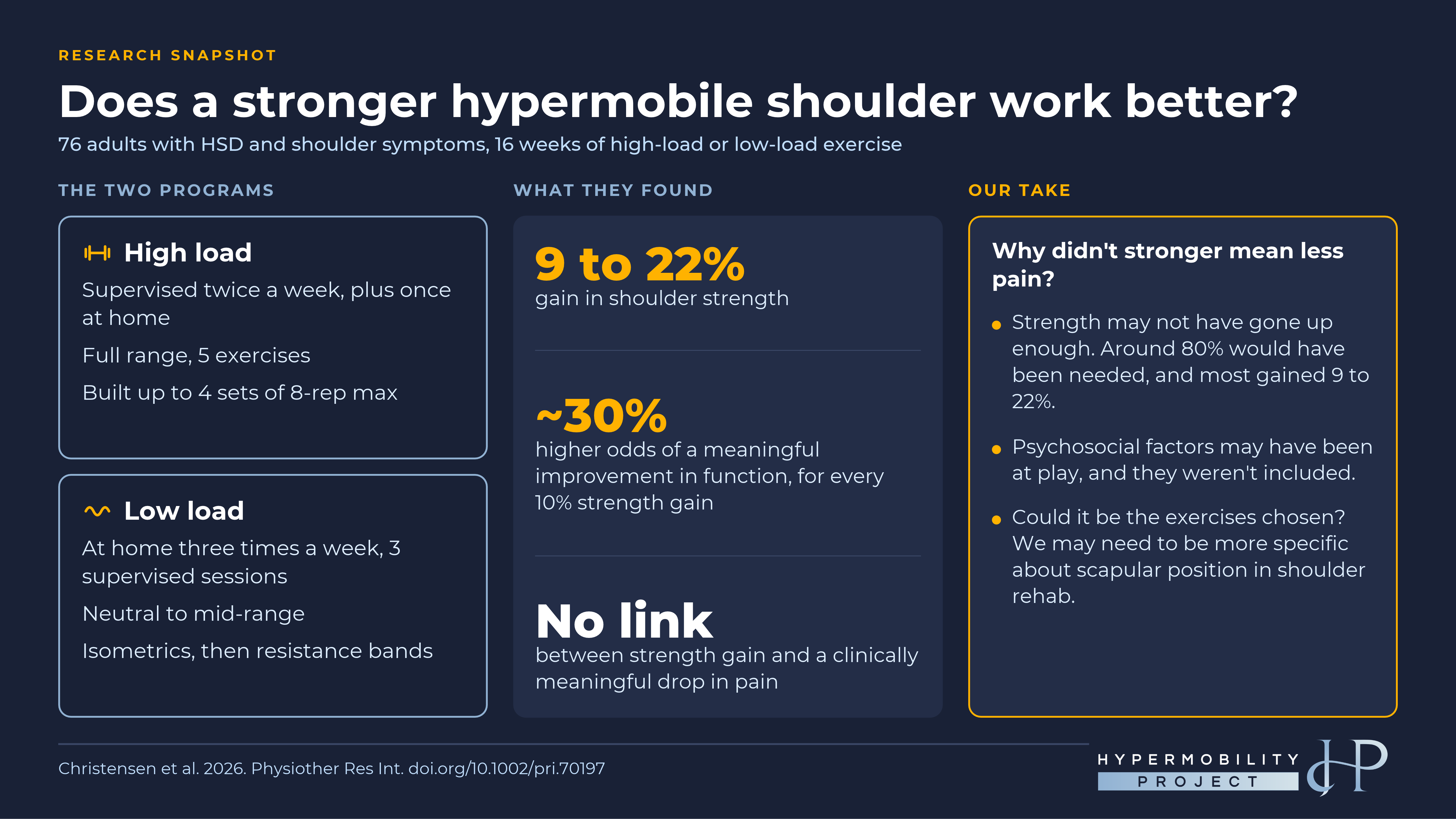
For 16 weeks, the two groups did quite different programs (Liaghat et al., 2022).
High load: supervised twice a week, plus once at home, through full range. Five exercises: side-lying external rotation, prone external rotation at 90° of abduction, prone horizontal abduction, supine scapular protraction, and seated elevation in the scapular plane. Load started at half of a 10-rep max in week 1 and built up to 4 sets of 8-rep max by weeks 10 to 15.
Low load: at home, three times a week, with only three supervised sessions in total, kept in neutral to mid-range. Nine exercises in three phases: isometrics with posture correction, isometric rotation and abduction, then resistance band rotation and abduction plus single arm raises in four-point kneeling. The exercises progressed, but the load didn't.
Both groups also had education on scapular correction and joint protection (Liaghat et al., 2022). The researchers then checked whether the people who got stronger had better shoulder function, less pain, or felt importantly better (Christensen et al., 2026).
What they found
Strength went up by about 9 to 22% (Christensen et al., 2026).
Gains in external rotation and scaption strength were linked to better function. Every 10% gain came with around 30% higher odds of a meaningful improvement in function.
Strength gains weren't linked to a meaningful drop in pain.
Then comes the catch. Strength only explained a small part of the change. To get a meaningful improvement in function from strength alone, someone would have needed around 80% more external rotation strength. For pain, it was over 100% more scaption strength. Very few participants reached those levels (Christensen et al., 2026).
The authors' own conclusion is that strength may help, but that relying on strength gains alone to drive a meaningful change doesn't seem reasonable (Christensen et al., 2026).
The rest of the trial
Other papers from the same trial found heavy loading was well tolerated, with no serious adverse events (Liaghat et al., 2022) and very little pain during exercise (Liaghat et al., 2025), though more short-term muscle soreness and headaches (Liaghat et al., 2022). It gave a small edge in function at 16 weeks (Liaghat et al., 2022), but not at one year (Liaghat et al., 2024). Expectations, confidence and fear of movement were also linked to how people did (Dolsø et al., 2023).
What we see clinically: control comes first
Honestly, these findings don't surprise us.
This was a standard strengthening program. It measured how strong the cuff got. It didn't measure the coordination and pattern of the arm motion (both very difficult to quantify for research unfortunately).
Pain is about more than shoulder strength. Keeping the humeral head centred in the socket as the arm moves takes coordination across many muscles, and good motor control. In hypermobile shoulders we often find the external rotators overactive and gripping. That changes where the humeral head sits in the socket, and how the joint moves as the arm goes up into elevation. You can make that cuff stronger and still not fix the problem. Sometimes you make it worse.
We find control of the arm in the socket is integral to limiting recurrent micro-injury and pain. So for us, strength isn't the first goal. Control is, and strength comes after.
We can push hypermobile shoulders to get stronger, but it can come at a cost. Other symptoms, like headaches, can flare, and that often means people stop doing their exercises. This trial saw it too: headaches were twice as common with heavy loading (40% vs 20%; Liaghat et al., 2022).
We'd also love to know what scapular position people were taught. Both groups had education on scapular correction, but the papers don't describe it, so we don't know whether the scapula was set into elevation or protraction. That can often affect whether people get pain, particularly if they also have neck or thoracic outlet symptoms.
That doesn't make strength unimportant. In this study, stronger shoulders were more functional shoulders, even where pain didn't change much. It's still better to have a painful functional arm than a painful non-functional arm. Not painful and functional is always the ideal.
Clinical gem: if a hypermobile shoulder is getting stronger but no less painful, look at how it's moving, not only how much it can lift. Where does the humeral head sit at rest? What happens to it as the arm goes into elevation? Are the external rotators switching off when they should?
Limitations
It's an exploratory analysis, so it shows a link, not cause and effect.
The links were weak, and there was no correction for multiple comparisons.
Psychosocial factors weren't included, and muscle activity and motor control weren't measured.
Researching hypermobile shoulders is hard. The group is so heterogeneous that two people with the same diagnosis can have completely different shoulders, and that makes clean answers tough to get. We need more researchers willing to take that on, and we're glad this team keeps doing it.
What this means in practice
Worth your time if you treat hypermobile shoulders. Just don't read it as "load more and they'll be fine".
Assess control as well as strength. Look at humeral head position, how the cuff behaves into elevation, and whether the external rotators are gripping.
Don't rely on strength alone. It explains only part of the change, and it wasn't linked to meaningful pain relief (Christensen et al., 2026).
Don't fear load. Heavier loading was well tolerated in this trial (Liaghat et al., 2022, 2025). Warn patients about short-term soreness and headaches.
A question to leave you with: in your hypermobile shoulder patients, is it weakness, or control?
If you'd like more on the difference between laxity and instability, read Laxity, Hypermobility and Instability. Our clinician tools and the Diagnosing Hypermobility Masterclass go further into assessing hypermobile patients.
References
Christensen, T., Juhl, C. B., Juul-Kristensen, B., Skou, S. T., Søndergaard, J., Søgaard, K., & Liaghat, B. (2026). Association between changes in shoulder strength and self-reported shoulder symptoms in patients with hypermobility following 16-weeks of high-load or low-load exercise: A secondary analysis of an RCT. Physiotherapy Research International, 31(2), e70197. https://doi.org/10.1002/pri.70197
Dolsø, M., Juul-Kristensen, B., Skou, S. T., Søgaard, K., Søndergaard, J., Juhl, C. B., & Liaghat, B. (2023). Psychological factors and symptom duration are associated with exercise-based treatment effect in people with hypermobile shoulders: A secondary analysis of a randomised controlled trial. Musculoskeletal Science and Practice, 66, 102798. https://doi.org/10.1016/j.msksp.2023.102798
Liaghat, B., Juul-Kristensen, B., Christensen, F. H., Nissen, S. E., Skou, S. T., Søgaard, K., Søndergaard, J., & Thorlund, J. B. (2025). Pain trajectories and exercise-induced pain during 16 weeks of high-load or low-load shoulder exercise in patients with hypermobile shoulders: A secondary analysis of a randomized controlled trial. Scandinavian Journal of Pain, 25(1). https://doi.org/10.1515/sjpain-2024-0072
Liaghat, B., Juul-Kristensen, B., Faber, D. A., Christensen, E. O., Søgaard, K., Skou, S. T., Søndergaard, J., & Juhl, C. B. (2024). One-year effectiveness of high-load compared with low-load strengthening exercise on self-reported function in patients with hypermobile shoulders: A secondary analysis from a randomised controlled trial. British Journal of Sports Medicine, 58(7), 373-381. https://doi.org/10.1136/bjsports-2023-107563
Liaghat, B., Skou, S. T., Søndergaard, J., Boyle, E., Søgaard, K., & Juul-Kristensen, B. (2022). Short-term effectiveness of high-load compared with low-load strengthening exercise on self-reported function in patients with hypermobile shoulders: A randomised controlled trial. British Journal of Sports Medicine, 56(22), 1269-1276. https://doi.org/10.1136/bjsports-2021-105223
This resource is designed for education and general guidance only. It is not a replacement for personalised medical advice.