
Why Hypermobility Gets Missed: Ending the Diagnostic Delay
Hypermobility: Why Clinicians Need to Start Spotting the Zebra
I'm bendy. So are my kids, and so are most of the people I see in clinic. I'm Sharon Hennessey, founder of The Hypermobility Project and a physiotherapist for nearly 30 years, most of them spent working in hypermobility. I live and breathe it in my life, my work and my art.
Why hypermobility gets missed: a 10 to 22 year diagnostic delay
In medicine we're taught that when you hear hoofbeats, think horses, not zebras. But the average wait for a diagnosis of symptomatic hypermobility is still somewhere between 10 and 22 years. That diagnostic delay is why so many patients are told it's "just anxiety" or "just bendy".
On my own, I can only change the life of one patient at a time. Together, we can multiply our impact. I want you to be the clinician who spots the zebra. If you're not sure where to start, my Red Flags blog post is a good first step.
Who is hypermobile? There's often a type
A lot of us who work in health are hypermobile too. In my experience, there's a type:
Highly motivated and high-achieving
Always running fast
A perfectionist
A little neurospicy (diagnosed or not), often with a neurospicy family at home
It's the joy, the uncertainty, the pressure, the tears, the love of life and the screaming, all rolled into one. Sound familiar? You might be one of us. If not, there's a good chance you recognise it in some of your clients.
Why I make art about hypermobility
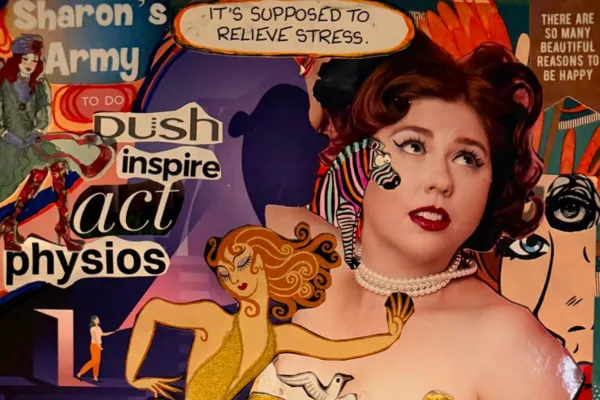
I made a collage of all the different versions of me over the years: the woman, the feminist, the artist, the physio, the CEO and the little zebra. I made it to relieve stress, or at least that's what the speech bubble says. In the top corner it reads "Sharon's Army, to push, inspire and act."
That's the heart of why I teach medical and allied health professionals about hypermobility. My tiny goal is to change the way the world sees symptomatic hypermobility. You can read more of my story on the About page.

Teaching hypermobility the evidence-informed way
My teaching comes straight from the clinic. Evidence-informed, to me, means the combined power of published research and what we see in real patients every day. That means:
A clear framework and flowcharts you can use on Monday morning (see my clinician tools)
Honesty about where the evidence is thin
Guidance on working within your scope and knowing when to refer
Never dismissing a patient because they don't fit neatly in a box
Why the new hypermobility criteria matter now
The updated adult diagnostic criteria are due out on 1 December. I was in the room when the 2017 criteria were discussed. Since then, as leader of Not Just Bendy's EDS Society Core Network of Excellence, I've been part of the consultation on the new criteria through the Road to 2026 process, from multiple rounds of surveys to some very lively debate at our core network meetings.
A solid grasp of the current criteria is the base everything new will build on. We need to know where we are before we know where we're going.
My masterclass, Diagnosing Hypermobility: Clinical and Ethical Masterclass, current criteria for diagnosing hEDS and HSD alongside epidemiology, paediatric criteria, red flags, scope, referral, finding your multidisciplinary team (MDT), ethics, and how to communicate clearly with patients and colleagues. A live Q&A on Tuesday 8 December at 6:30pm Brisbane time will unpack what the new criteria mean for practice. If you want something to take straight into clinic, the resource packs pair well with the masterclass, and the Co-occurring Conditions course is the next step. For differentials, see my post on vEDS, Marfan and Loeys-Dietz syndromes.
Who is teaching you?
I graduated with a Bachelor of Physiotherapy (Hons) from the University of Queensland in 1997 and have delivered more than 15,000 physiotherapy sessions across hospital, rehabilitation and private practice. I'm the founder and principal physiotherapist of Not Just Bendy Hypermobility Services, recognised as a CORE Network of Excellence by the Ehlers-Danlos Society in 2024, and I was named Physiotherapist of the Year at the 2024 Allied Health Awards. I've trained more than 2,000 clinicians, and I've presented at the Ehlers-Danlos Society Global Learning Conference (2025) and at Australian Physiotherapy Association, Australian Rheumatology Association, Mast Cell Activation Syndrome and Australian POTS conferences. I'm a co-author of an international expert consensus paper on upper cervical instability in hypermobility (Frontiers in Medicine, 2023). You can also hear me talk about hypermobility across the life stages on the Healthy Banter podcast, and connect with me on LinkedIn. My courses are designed to give you hypermobility education for clinicians that you can use the next day.
Stay in the loop on hypermobility
The new criteria are coming, and the conversation is moving fast. Sign up to The Hypermobility Project newsletter for practical updates on hypermobility, what the new criteria mean for your practice, and resources you can use with your clients.
Join here for more information about my courses and resources